
Reviewed by: Göran Stenmark
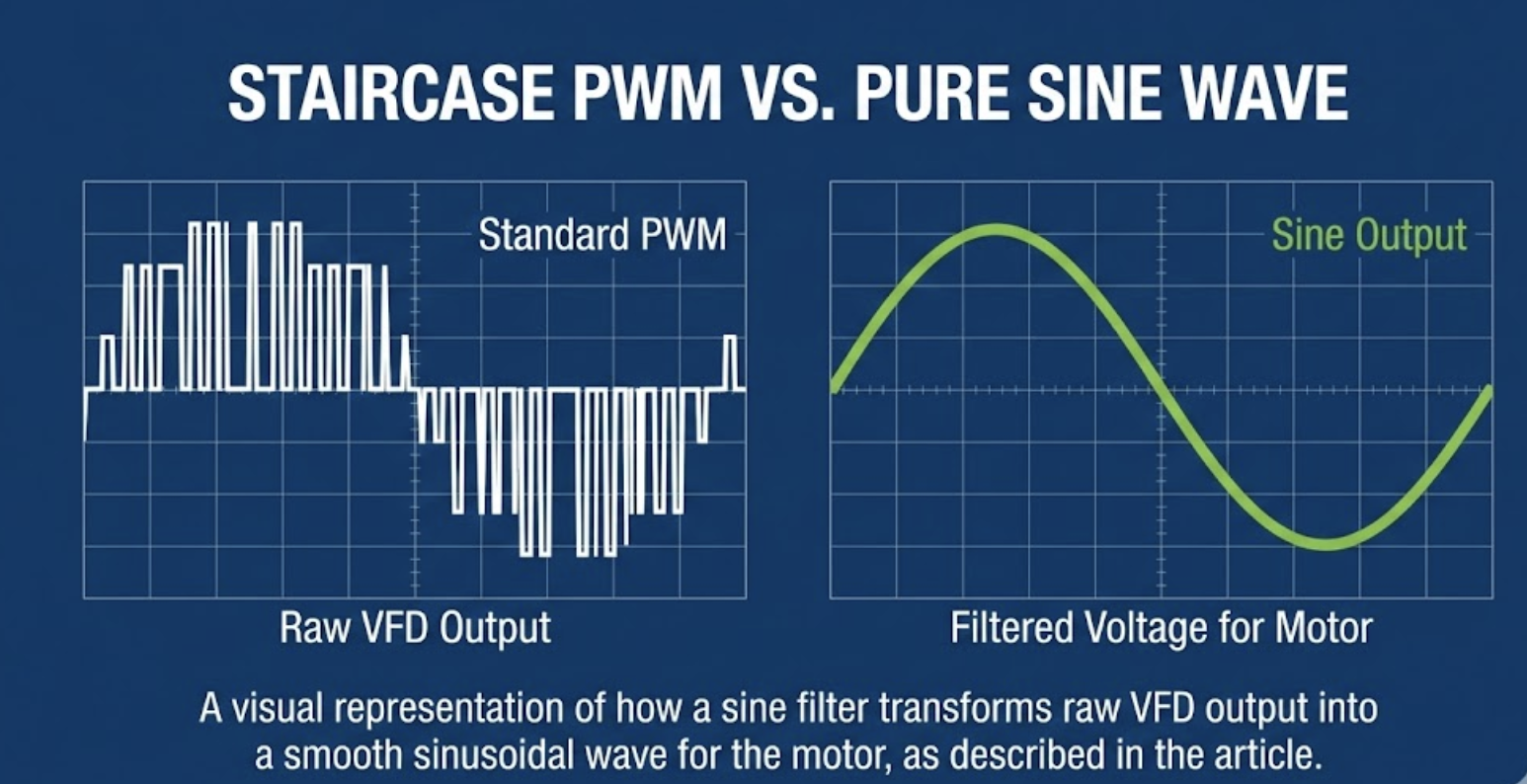
The term “sine drive” is often presented as something new or fundamentally different from traditional variable frequency drives. In reality, it describes what the motor receives, not a new type of drive technology.
Many people also confuse the term with mathematical sine waves or assume it refers to a special type of AC system. In industrial applications, however, a sine drive simply means that the motor is supplied with a voltage that is close to a pure sinusoidal waveform.
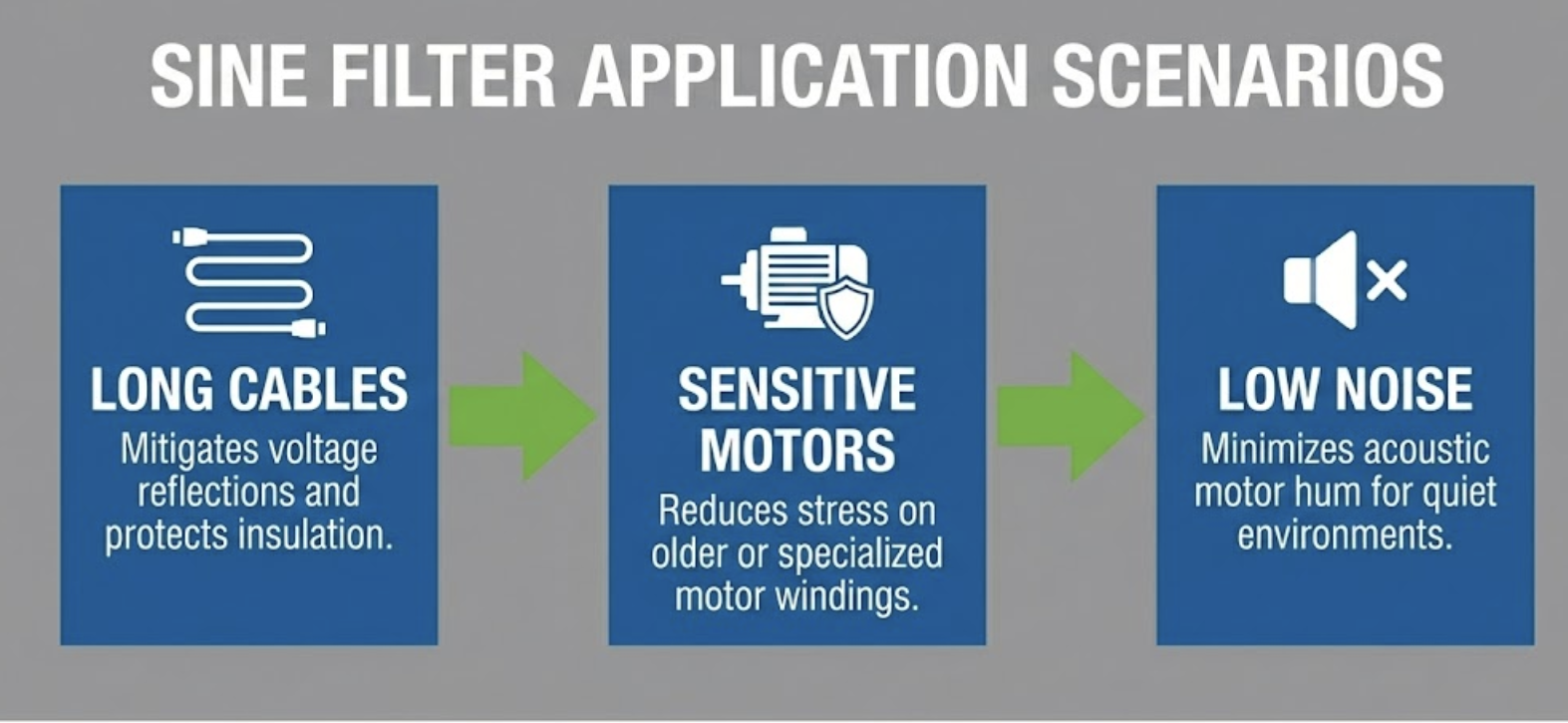
This reduces motor noise, limits insulation stress, and is beneficial in applications with long motor cables or sensitive motors.
Different technologies – same result
There are different ways to achieve a sine output:
- Drives with an internally integrated sine filter
- Drives using higher switching frequencies and compact filters
- A standard variable frequency drive combined with an external sine filter
In larger or more complex installations, sine-output solutions can also be implemented using modular converter platforms as part of a customized system design.
Regardless of how it is implemented, the functionality is the same: the motor sees a smooth, sinusoidal voltage.
The CG Emotron solution
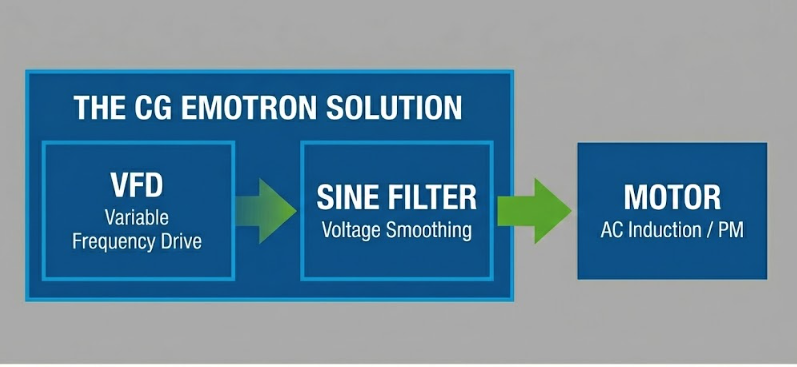
CG Emotron delivers sine-output solutions using a proven variable frequency drive combined with an external sine filter.
This approach:
- Delivers the same high-quality sine output as so-called “sine drives”
- Uses robust, well-established drive technology
- Can be supplied as a complete solution, with drive and sine filter installed together in the same cabinet
Producing a sine output does not require new or experimental technology, which may carry higher costs due to newer components. Our solution focuses on reliability, performance, and long-term value.
Download for more information: CG Emotron FDU VFX Technical Catalogue
When is a sine filter needed?
It is important to note that many applications do not require a sine filter at all.
CG Emotron drives already feature low noise levels and smooth voltage characteristics, which are sufficient for most installations.
When a sine filter is used, it should be done deliberately. While it improves voltage waveform quality, it can also slightly reduce overall system efficiency due to additional losses.
Areas and situations that may require a sine filter
Experience you can rely on
CG Emotron has been working with drive solutions and sine-output applications for over 40 years. We help customers choose the right solution for their application, without unnecessary complexity.
If you have questions about sine drives, sine filters, or motor-friendly drive solutions, you are always welcome to contact our skilled service technicians at: service.se@cgglobal.com
Frequently asked questions
Is a Sine drive a different type of drive?
No. A sine drive is typically a standard frequency drive combined with filtering technology that smooths the output voltage. The internal drive technology remains conventional — the difference lies in the waveform quality seen by the motor.
Is a Sine wave AC or DC?
A sine wave is a waveform shape, not a type of current. Most AC (alternating current) from the electrical grid is sinusoidal. Sine-output drive solutions recreate that smooth AC waveform for the motor.
Why do motors benefit from a sinusoidal voltage?
Electric motors are designed to operate on sinusoidal grid voltage. When supplied with steep voltage pulses from a standard drive output, additional electrical stress can occur. A sine-output solution reduces dv/dt stress, lowers acoustic noise, and protects motor insulation.